
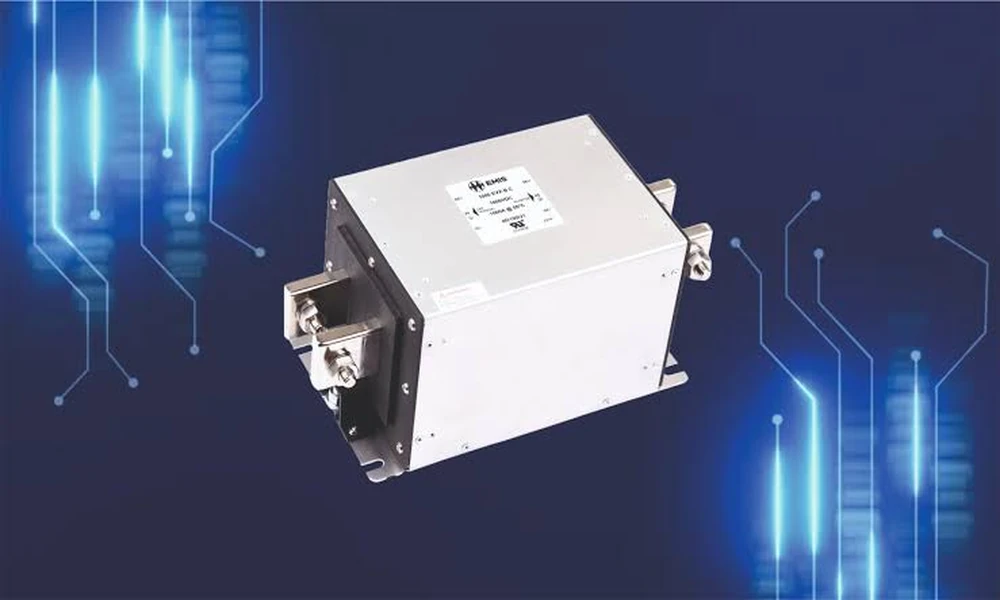
Plug a cheap phone charger into the same extension board as an old AM radio and you may hear it: a buzz or crackle that rises and falls with the charger’s load. That sound reveals energy escaping where it should not. Every switching power supply, motor drive and microcontroller produces some of this unwanted energy, and an EMC filter exists to stop it travelling along the power cord into neighbouring equipment, or entering a device from outside.
Electromagnetic compatibility describes two duties at once. A product must avoid polluting its surroundings with interference, and it must keep working when interference arrives from elsewhere. Filters help with both, which is why EMI RFI filters are standard parts in most mains-powered designs, from washing machines and air conditioners to patient monitors and factory controllers.
Where Does Unwanted Electrical Noise Actually Come From
Modern electronics switch currents on and off very fast. A switch-mode power supply chops the incoming mains thousands or even millions of times per second, and each sharp edge contains a spread of high-frequency energy. Variable-speed motor drives, LED drivers, inverters and digital clocks behave the same way. Without EMI RFI filters at the power entry, part of that energy flows back along the supply wires, and part leaks into the air from cables and circuit tracks acting like tiny antennas.
The effects range from irritating to serious. Interference can cause flicker on displays, false readings on sensors, data errors on communication lines and random resets in control boards. In an industrial panel, a drive that pollutes the supply can upset a programmable controller mounted a few centimetres away. The equipment that suffers often belongs to someone else, and a well-chosen EMC filter on the offending drive usually cures the trouble at the source.
What Separates Conducted Emissions from Radiated Emissions?
Conducted emissions travel through wires, mainly the power cord. Test labs measure them with a line impedance stabilisation network placed between the mains and the product, typically across a band from about 150 kHz to 30 MHz. Radiated emissions travel through the air and are measured with antennas, usually from 30 MHz upwards. Mains EMI RFI filters mostly tackle the conducted side, although cleaning up the cord also cuts radiation, because a noisy power cable behaves like an antenna too.
Radiated problems often need other fixes as well: shielding, careful board layout, ferrite clamps on cables and short return paths. Filtering works best as one layer in that plan. Many electrical components manufacturers offer ferrite cores, shielded enclosures and filtered connectors side by side for this reason, since an emissions failure rarely yields to a single part on its own.
How Do Filters Handle Common-Mode and Differential-Mode Noise?
Noise takes two routes. Differential-mode noise flows out on the live wire and back on the neutral, just like the normal supply current. Common-mode noise travels on both wires in the same direction and returns through earth or stray capacitance to the chassis. A typical EMC filter answers each with different parts. X capacitors connected between line and neutral shunt differential noise, while Y capacitors from each line to earth divert common-mode currents. A common-mode choke, two windings on one magnetic core, blocks noise flowing the same way on both wires yet lets the normal supply current pass with little loss.
Y capacitors create a small leakage current to earth, and safety standards cap it, with tighter limits for medical equipment that touches patients. That limit shapes filter design for hospital devices, which often rely more on chokes and less on large Y capacitors. Engineers buying from an EMI filter manufacturer in India for medical or laboratory products should ask for the leakage figure at the rated voltage and frequency before approving a design.
Which Standards Set the Limits for Emissions and Immunity?
Think of the international CISPR publications as rulebooks written for each product family, setting emission limits and test methods: CISPR 11 for industrial, scientific and medical equipment, CISPR 14-1 for household appliances and tools, CISPR 32 for multimedia equipment, and CISPR 25 for components fitted in vehicles. The IEC 61000 series covers immunity, with tests for electrostatic discharge, fast transient bursts, surges and conducted disturbances. National standards, including Indian ones, often adopt these documents. A reputable EMI filter manufacturer in India should be able to quote insertion loss measured by the CISPR 17 method, the accepted way of characterising filters.
Where Should an EMC Filter Sit Inside a Product?
Placement decides whether a good filter actually works. The filter belongs right where the power cord enters the enclosure, mounted on clean metal bonded to the chassis so diverted noise has a short path to earth. If the unfiltered input wire runs across the board next to the filtered output, noise simply couples across and skips the filter altogether. To avoid that, several electrical components manufacturers build the filter into an IEC inlet, combining socket, fuse and filter in one housing.
Choosing the filter itself starts with rated current, voltage and the insertion loss needed at the frequencies where the product failed, or nearly failed, its pre-compliance scan. Ask an EMI filter supplier in India for insertion loss curves under both common-mode and differential-mode conditions, and remember that published curves come from a 50 ohm test setup while real circuits differ. Testing samples inside your own product is the only dependable proof.
Does Every Mains-Powered Device Need Its Own Filter?
Most mains-powered devices with switching electronics need some form of EMC filter, either built onto the circuit board or fitted at the power inlet. Very simple loads such as heaters or plain filament lamps may meet emission limits without one. For anything with a power supply, motor drive or processor, planning the filter early takes far less effort than redesigning after a failed test, and an EMI filter supplier in India can share measured data that shortens that work.
