
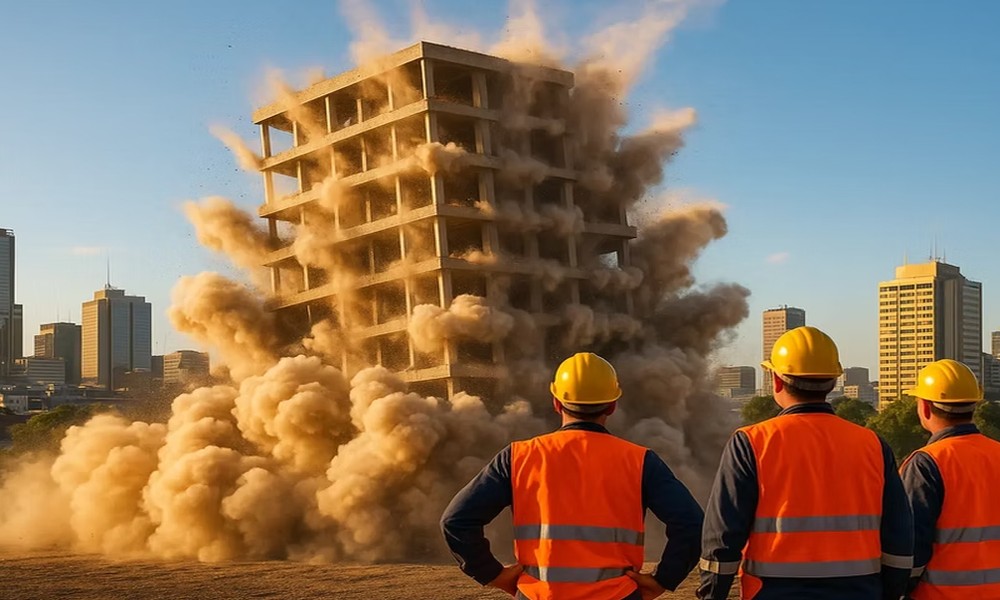
Most workers who walk onto a demolition site for the first time assume the job is straightforward – knock things down, clear the rubble, move on. That assumption is exactly why the industry sees so many avoidable incidents, licence disputes, and stalled careers. The unit demolition CPCCDE3016 exists precisely because demolition is one of the few trades where the gap between what workers think they know and what they actually need to know can have life-altering consequences. What this qualification teaches goes well beyond a checklist – it fundamentally changes how a worker reads a site before a single tool is picked up.
The Hidden Complexity of Demolition
Demolition is often treated as the blunt end of construction – a job that requires muscle more than method. But experienced site managers across Australia will tell you the opposite is true. Taking down a structure demands a sharper understanding of how it was built than the original builders needed. You are working backwards through engineering decisions made decades ago, often without complete documentation, in conditions that change the moment the first wall comes down. Workers who do not understand load paths, structural interdependency, and sequencing do not just make sites unsafe – they create collapse risks that no amount of PPE can compensate for.
Licencing Realities
The regulatory landscape for demolition work varies meaningfully between Australian states and territories, and this catches workers out more than they expect. In some jurisdictions, demolition of any load-bearing structure above a certain size requires a formally licensed demolisher on site, and that licence pathway runs directly through units like CPCCDE3016. Workers who skip this step can find themselves technically non-compliant even when employed by a licensed contractor, because the obligation does not rest solely with the business – individual workers carry responsibility too. Understanding this distinction early saves considerable grief later, particularly for those who eventually want to run their own demolition operations.
Where Most Workers Get Tripped Up
The section of the unit that catches workers off guard most consistently involves service identification and disconnection protocols. Gas lines, live electrical feeds, stormwater and sewage connections – a surprising number of experienced labourers have worked around these for years without ever formally learning how to trace, verify, and confirm their isolation. Working through this in the context of an accredited unit, with documented assessment, forces a level of precision that on-the-job habit rarely demands. It is worth noting that the majority of serious demolition incidents investigated by Safe Work Australia in recent years have involved either unidentified services or incorrect assumptions about structural behaviour. The training addresses both directly.
Portability Across States
One underappreciated aspect of nationally accredited units is that the qualification follows the worker, not the employer. Someone who completes this training in South Australia and later picks up work in Queensland or Western Australia does not need to repeat the learning – the credential is recognised across borders. For workers in the demolition sector, which regularly sees large project-driven labour movements between states, this portability has real career value. Contractors assembling crews for major infrastructure or urban renewal projects increasingly use qualification status as a first-pass filter when reviewing applicants, particularly when site safety obligations require documented competency from every member of the team.
Supervisors Notice the Difference
There is a measurable shift in how formally trained workers approach a site compared to those who have picked up knowledge informally over the years. Supervisors who have managed both types will often describe it as a difference in situational awareness – the trained worker asks different questions, identifies issues earlier, and is less likely to proceed when something does not feel right. That habit of verification, rather than assumption, is not personality-driven. It is trained behaviour. And in an industry where one misjudgement can compromise an entire structure, employers who have experienced both tend to have a clear preference.
Conclusion
The real value of completing demolition CPCCDE3016 is not a certificate on a wall – it is the shift in how a worker thinks once the training is done. Australian demolition sites are unforgiving environments where the margin for assumption is narrow and the consequences of getting it wrong are serious. Workers who invest in formal, assessed competency carry more confidence onto site, earn more trust from supervisors, and build careers that hold up under scrutiny. In an industry where the difference between a good worker and a great one often comes down to what they catch before it becomes a problem, that training-shaped instinct is worth more than most people initially expect.
