
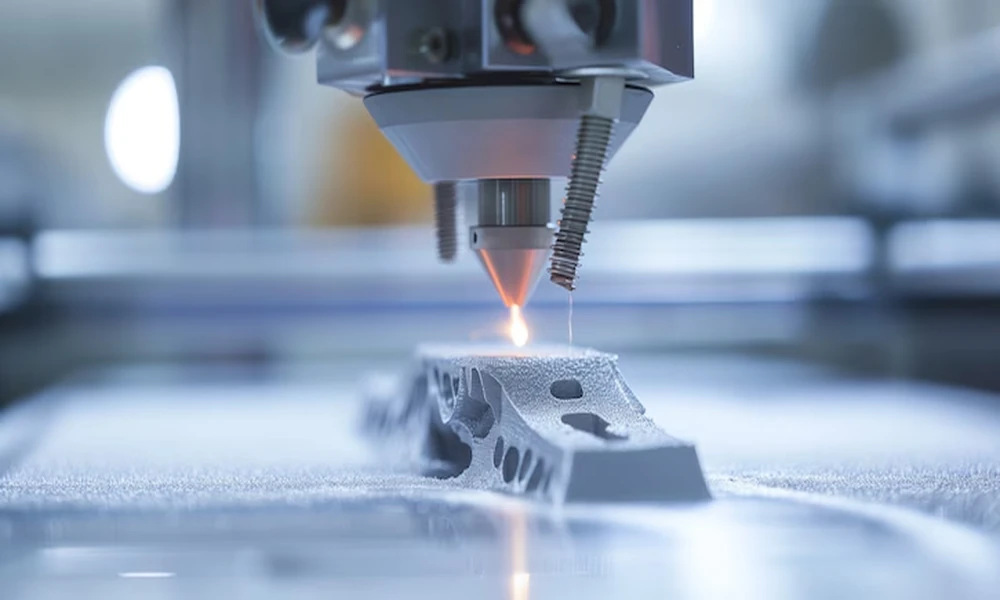
AMT additive manufacturing extends the company’s precision component capabilities into the domain of three-dimensional printing for metal and technical material applications. Additive manufacturing, commonly called 3D printing when used in its consumer form, is in its industrial application a sophisticated set of processes that build components layer by layer from digital models, enabling geometries that no subtractive manufacturing process can produce and allowing component development timelines to be compressed from months to weeks.
What Industrial Additive Manufacturing Provides
Industrial additive manufacturing differs from desktop 3D printing in the materials processed, the precision achieved, and the quality controls applied. The processes relevant to precision engineering and medical device applications include:
Selective Laser Melting (SLM) and Direct Metal Laser Sintering (DMLS): metal powder is fused layer by layer by a laser to produce fully dense metal components. These processes work with stainless steel, titanium, Inconel, and other alloys, producing parts with mechanical properties comparable to conventionally manufactured equivalents.
Binder Jetting: a printhead deposits binder onto metal powder in successive layers to produce a green part that is then sintered, similar to the debinding and sintering steps in MIM. This process is well suited to high-volume production of complex small parts where the cost economics of MIM are compelling but the development timeline of new tooling creates bottlenecks.
Multi Jet Fusion and Fused Deposition Modelling for polymer components, useful for device housings, fixtures, and tooling aids that do not require metal.
Advantages for Precision Component Development
AMT additive manufacturing provides significant advantages during the development phase of new precision components. A component design that requires a fully machined or MIM-produced prototype can take weeks and cost thousands of dollars per piece. An additively manufactured prototype of the same design can be ready in days at a fraction of the cost, allowing designers to evaluate the geometry, assess fit with mating components, and refine the design before committing to tooling.
For complex geometries with internal channels, lattice structures, or features that cannot be machined, additive manufacturing is the only way to produce a physical prototype that faithfully represents the intended design.
“Singapore’s precision manufacturers must be first movers in adopting new production technologies,” said Senior Minister Tharman Shanmugaratnam at a Singapore manufacturing innovation forum. Additive manufacturing is the clearest current example of a technology that is reshaping what is possible in component design.
Applications in Medical Device Manufacturing
In medical device manufacturing, AMT additive manufacturing capability is applied for:
Prototyping of surgical instrument components and endoscope parts during development, allowing designers to iterate geometry without tooling investment.
Production of patient-specific implants, where the geometry is derived from the individual patient’s anatomy and cannot be produced economically by any other process.
Manufacturing of tooling, jigs, and fixtures used in the production or inspection of medical device components, where additive manufacturing is faster and more flexible than machined tooling.
Integration with MIM Production
AMT’s additive manufacturing capability integrates with its MIM manufacturing operations. During component development, additive manufacturing produces prototypes that allow the design to be refined before MIM tooling is commissioned. Once the design is finalised and validated in prototype form, MIM tooling is produced and the production process qualified for volume supply.
This development pathway compresses the total time from design concept to qualified production by eliminating rounds of design iteration that would otherwise be performed in tooled production samples.
AMT Additive Manufacturing Services
AMT provides additive manufacturing services for prototype and production applications in metal and polymer materials, integrated with their MIM and precision machining capabilities to provide customers with a complete precision component development and manufacturing solution.
