
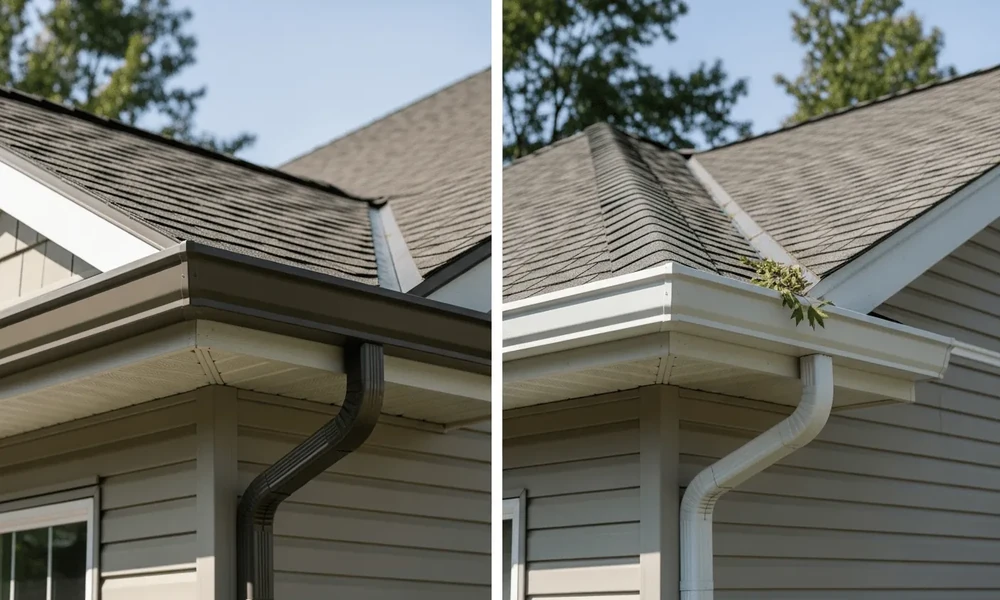
Three thousand dollars. That is roughly what a soaked foundation repair can cost a homeowner, and a set of clogged sectional gutters is one of the most common ways people get there. Rain doesn’t care about your weekend plans or your budget. It finds the seam you forgot about.
Here’s the short version: seamless gutters win for most homes because they remove the joints where leaks start in the first place. A single run of aluminum formed on site from one coil has no mid-span seams to fail, no gaskets to dry out, and nothing to catch debris as water slides past. Sectional systems still make sense in a few situations, and I’ll get to those. But if you’re replacing a full run, you should know that bringing in Professional gutter installation services in Paducah with a forming machine usually costs less than you expect once you price out a decade of patch jobs.
What follows is how I’d compare the two systems, how sizing actually works, and the mistakes I see homeowners make when they try to save money on the wrong part of the project. You’ll walk away with a decision framework you can use this weekend, standing in your driveway with a ladder.
Seamless versus sectional: the honest comparison
Gutters are simple machines. They catch water and move it away from your walls, your fascia, and your foundation. The whole game is minimizing failure points, and every joint in a gutter is a failure point waiting for a season or two.
On a typical ranch home, a sectional system might arrive in ten foot pieces joined by slip plates or connectors. That’s seven to nine joints on a single side of the house. Each one has a gasket or a bead of sealant that expands in summer heat and contracts in winter cold. Seams fail because two different materials move at two different rates. That’s not a manufacturing defect. It’s physics.
Seamless runs are formed at your house from a single coil of metal, cut to the exact length of each wall, and hung with hidden hangers. The only joints are at corners and at the downspout outlets, and a careful installer seals those properly.
| Factor | Seamless | Sectional |
|---|---|---|
| Leak points | Corners and outlets only | Every ten foot connector |
| Curb appeal | Long unbroken lines | Visible seams and joints |
| Installation | Formed on site, custom fit | Cut and assembled by hand |
| Best for | Most homes, new builds, replacements | Tiny sheds, short runs, tight budgets |
| Repair style | Reseal a corner if needed | Chase leaks joint by joint |
My read: if your run is longer than twenty feet, seamless is the only sensible option. The labor math flips fast, and you stop thinking about your gutters entirely, which is exactly what you want from a roof edge.
How to size a gutter correctly
Most homeowners never think about capacity, and then a two inch rainstorm turns their gutters into a waterfall at the corner. Gutter sizing depends on two things: the square footage of roof draining into each run, and the maximum rainfall intensity your region sees.
Here’s the part people miss. A gutter that’s too small doesn’t fail gradually. It backs up under the roof edge and rot starts at the fascia board, which is the piece of wood the gutter hangs on. Now it’s a carpentry job. The Department of Energy has long noted that managing moisture around a home’s envelope is central to keeping the structure sound, and the roof edge is where that work begins.
As a general guideline, standard five inch K-style gutters handle a moderate roof area, while six inch gutters are the safer pick for larger roofs, steep pitches, or homes with long unbroken runs. Oval downspouts move more water than rectangular ones of similar size. Ask your installer which size they plan to run and why. If they can’t explain the math in a sentence, keep calling around.
Pitch matters too. Gutters need a slight slope toward the downspout, and 6-inch seamless systems give installers more room to work with that slope without looking crooked on the wall.
Choosing the right material for your house
Aluminum is the default, and for good reason. It’s light, it doesn’t rust, and it comes in enough colors to match most trim. Copper costs several times more but ages into a patina that some older homes genuinely deserve. Steel holds up to ladders and branches but can rust at cut edges if it isn’t finished properly.
Vinyl is the budget choice, and I’d skip it for anything but a shed. It gets brittle in cold weather, and the joints are exactly where it cracks first. Seamless vinyl barely exists, so you’re stuck with sectional by default.
Color matters more than people think. The General Services Administration publishes design guidance that treats exterior building materials as part of a structure’s overall visual performance, not an afterthought. Your house works the same way. A gutter that matches the fascia and complements the roof blends in. A bright white gutter against dark trim doesn’t.
Push your installer on the finish. Factory painted aluminum holds color better than field painted, and gutter coil is available in dozens of standard shades.
The steps to run before you sign anything
No system survives bad installation. Here’s the sequence I’d follow:
- Walk the roofline yourself. Look for fascia rot, sagging runs, and stains on the siding below the gutter line. Point them out early so the quote covers repairs.
- Ask for hanger spacing. Hangers should be screwed in, not nailed, and spaced closely enough that the gutter can’t sag under a full load of water.
- Confirm downspout discharge points. Water needs to leave the foundation. Extension pieces or splash blocks should be part of the plan.
- Request the size and gauge in writing. A quote that just says “gutter replacement” leaves room for surprises.
- Get at least two estimates. Line them up side by side and compare scope, not just the bottom number.
One more thing. Consider gutter guards at the same time if you have trees close to the house. Leaves are the number one reason gutters clog, and the Census Bureau tracks just how much of the country’s population lives in wooded suburban areas, which tells you most people are dealing with this. Adding guards during installation costs far less than retrofitting them later.
And watch the weather. A crew installing on a dry day with no rain in the forecast can seal and test properly. A rushed install before a storm is how corners get missed.
When sectional still makes sense
There is a real case for sectional gutters, and I won’t pretend otherwise. Tiny sheds, a small porch roof, and short runs where a forming machine can’t reach. If you’re fixing one twelve foot run on a garden shed, buy the sections and spend a Saturday. That’s a fair trade.
For a house, run the numbers on repair versus replacement. If your existing gutters have failed at two or more joints, patching is throwing money at a doomed system. Each reseal job costs money and a weekend, and you’ll be back at it next spring.
Size the job to your house. A single-story ranch with a simple roofline is one of the easiest installs there is. A two-story with dormers and several valleys takes more planning and more time. Don’t expect the same quote for both.
Frequently asked questions about seamless gutters
How long do seamless gutters last?
Aluminum seamless gutters commonly last well over twenty years when they’re hung correctly and cleaned twice a year. Copper lasts decades longer. The seam-free design is the big reason the lifespan stretches that far.
Are they worth the extra cost?
For most homes, yes. The price gap over sectional is smaller than people assume once you factor in the elimination of repeat repairs. Think of it as buying silence from future leaks.
Do I need to clean them?
Yes. No gutter cleans itself. Guards cut the frequency, not the need entirely. Plan on a check each spring and fall.
Final word
Pick a system based on how long you plan to live there and how much you hate ladder work. If the answer is a long time and a lot, seamless wins, and it isn’t close. Get your estimate, ask the sizing question, and make the installer put the details in writing.
Here’s your next move: go outside, look up, and check for stains under the gutter line. If you find any, that’s your signal to get a real quote before the next heavy rain decides the schedule for you.
